Choosing between WP10, WP12 and WP13 can sound simple until three suppliers quote three different configurations. A family name alone does not tell our purchasing team the application, rated speed, emissions equipment or included accessories. That uncertainty can turn a promising price into an installation problem or a parts inquiry that starts again. I recommend comparing exact documented variants. At Weichaistore, we begin with engine identification, the intended job and a written supply scope before discussing which option deserves approval.
I compare WP10, WP12 and WP13 by the full engine model, application and documented rating, rather than choosing the biggest family number. I check installation interfaces, controls, emissions documentation and local service requirements against the proposed equipment. I then compare identical supply scopes, operating assumptions and delivery terms. For replacement parts, we need the engine serial number and component references. Official specifications help build a shortlist, but the actual configuration still needs technical confirmation before an overseas order is approved.
Our six questions help buyers compare evidence instead of adjectives. They also keep engine selection separate from parts fitment, because a family reunion does not make every component interchangeable automatically.
What does a WP10, WP12 or WP13 label tell me?
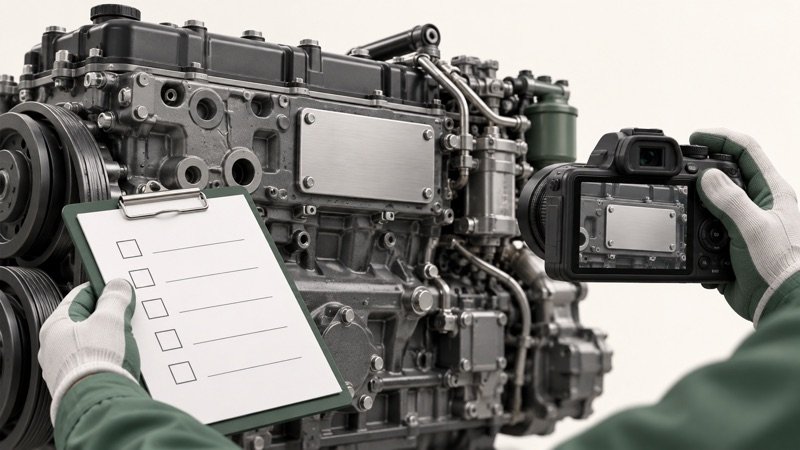
I treat WP10, WP12 and WP13 as the beginning of identification. Record the full model designation and serial number from the actual engine nameplate. Keep every suffix in the inquiry. Also identify the vehicle or equipment maker, model and serial number. For an existing installation, include photos of the engine and connected systems. A quote saying only ‘WP12 diesel engine’ leaves too much work for the receiving workshop.
Weichai’s current special-purpose vehicle pages provide specific examples: WP10, WP12 and WP13. The table records selected model rows, checked on 12 October 2026. Their listed applications include trucks and special-purpose vehicles. These are documentation examples, not interchangeable options or a stock list. The pages also warn that parameters can change. I request current documentation for the exact engine offered.
| Documented truck-engine example | Engine power / speed | Displacement | Listed emissions |
|---|---|---|---|
| WP10.340E22 | 250 kW / 2200 rpm | 9.726 L | Euro II |
| WP12.460E62 | 338 kW / 1900 rpm | 11.596 L | Euro VI |
| WP13.560E62 | 412 kW / 1900 rpm | 12.54 L | Euro VI |
How do I compare power and application correctly?
I compare each rating with its stated speed and application. The table shows engine power, not a complete machine’s capacity or a generator set’s electrical output. A higher figure does not establish a better purchase for every job. Ask the responsible equipment supplier to confirm the required operating range and duty against the actual vehicle, machine or generator configuration. Keep the comparison tied to useful work.
I describe the load, working hours, temperature, altitude and site conditions in the RFQ. For a replacement engine, ask the equipment maker or qualified technical reviewer whether the proposed variant is suitable. For a generator project, request the complete set’s own ratings and electrical specifications. I would not use a truck-engine table to promise generator output. The decimal points may look impressive, but they cannot complete an application review.
What must I confirm about installation and emissions?
I request installation drawings and an agreed interface checklist before discussing replacement approval. Check mounting points, flywheel housing, output connection, cooling arrangement, intake and exhaust layout, wiring, controls and available space against the delivered configuration. Identify accessories included with the engine and items the buyer must provide. These are our purchasing checks; the equipment maker or qualified engineer must resolve the actual integration requirements.
I verify emissions documentation for the exact model and intended destination. The official WP10.340E22 row lists Euro II and a mechanical injection pump. The WP12.460E62 and WP13.560E62 rows list Euro VI and CR+DOC+DPF+SCR. Those are model-specific entries on the linked pages. They do not prove that every family variant meets the same standard or that an offered unit is approved for import. Request the applicable evidence and installation requirements from the responsible supplier.
How do I plan service and verify replacement parts?
I identify who can maintain the chosen configuration locally. Weichai’s aftermarket framework covers service, parts, oils, technical products and remanufacturing. It provides useful categories for our support questions, not confirmation of assistance at a particular site. Ask for the correct manuals, maintenance schedule, diagnostic access where needed, warranty responsibilities and claims process. Confirm the specific engine and location with the proposed service provider.
I build the spare-parts inquiry from engine identification and component references. Our WP10/WP12 parts category and WP13 piston page are starting points, not confirmation of fitment across all variants. For parts claimed as genuine, use Weichai’s official verification guidance, including the applicable anti-counterfeit process. Origin verification and fitment remain separate checks. Request reference confirmation, quantity, condition and quoted availability for each component.
How should I compare quotations and operating costs?
I ask every bidder to quote the same engine designation and included assemblies. Separate the engine price from accessories, inspection, packing, freight, installation and commissioning. The International Trade Administration’s pro forma guidance includes item prices, weights, dimensions, delivery point, payment terms, estimated shipping date and quotation validity. I request those fields so our comparison has a common commercial basis. An estimated shipping date is not a guaranteed arrival date.
I compare operating costs using the same workload and ownership period. Request fuel data with its test conditions before accepting a savings claim. Add planned service, consumables, repair provision and downtime assumptions, marking estimates clearly. A lower engine invoice may leave other costs outside the quotation. Agree the named place and version with the selected trade rule: ICC’s Incoterms 2020 guidance explains the allocation of costs, risks and obligations. Three unexplained letters are not a delivery plan.
What should I send before approving an overseas order?
I send one organized inquiry containing identification, application, supply scope and destination. Include clear nameplate photos and any proposed alternative model. State the required inspection records and who reviews them. The checklist below helps our purchasing team request comparable answers. For parts, add readable component markings and quantities. For an engine, describe whether the request is for a complete assembly, basic engine or another defined scope.
- Full engine model, serial number and nameplate photos
- Equipment maker, model, application and operating conditions
- Requested engine scope or component references and quantities
- Installation, controls and required emissions documentation
- Inspection records, service responsibilities and written terms
- Destination, packing, delivery basis and requested schedule
I agree the acceptance checklist before payment and dispatch. Match the actual unit’s identification, included assemblies and documentation to the approved quotation. Specify any safe test, its conditions and the responsible reviewer in advance. Record packing protection and handling requirements for the shipment. Use our contact page for an engine or parts inquiry. We start with the details needed to review the request; a family name alone cannot settle the order.
Conclusion
I choose a documented engine configuration that suits the application, installation and support plan. Compare WP10, WP12 and WP13 at the exact model level. Send us nameplate photos, component references where relevant, quantities and destination so the next quotation starts with the right questions already answered.